Words of Hope in a Dry Winter
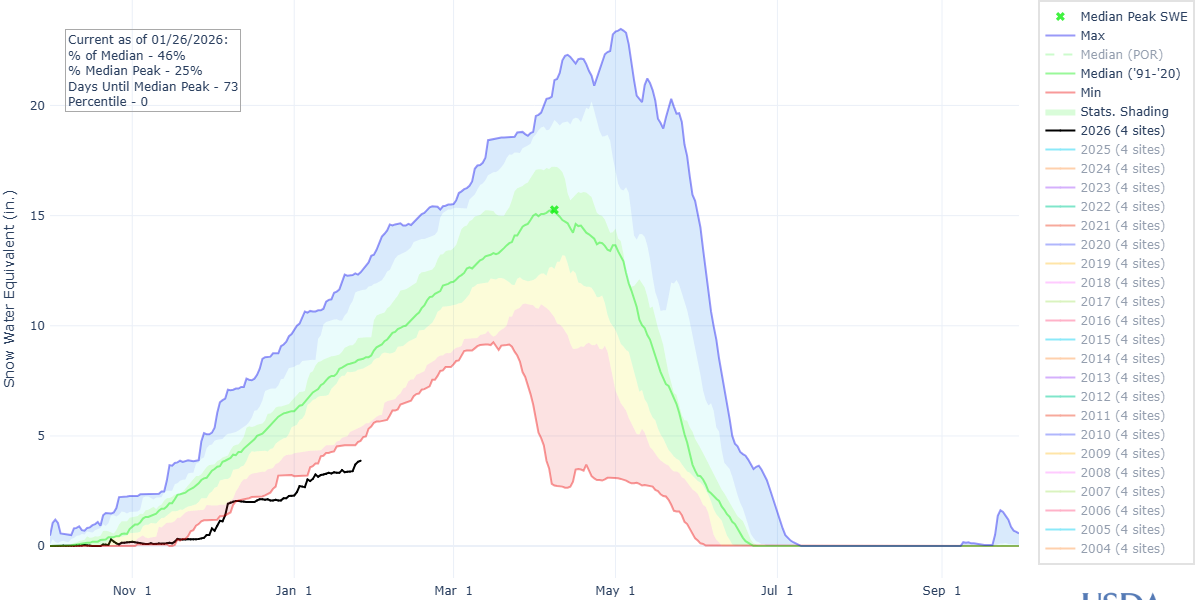
The black line is this year’s snow water equivalent so far: a record low. The red is the previous minimum.
Source: USDA Natural Resources Conservation Service
This winter has been dry. At 46% of the median, the Eagle River Watershed is facing the lowest snowpack on record for this time of year. This data is concerning, and impacts not only those who look forward to endless powder fields, but the entire community. Without minimizing these issues and concerns, however, there are still reasons to maintain optimism. Read on for some of the Eagle River Coalition’s sources of hope this unusual season.
Words of Hope from ERC Staff
Vicki Flynn
Executive Director
“Even with a low snowpack this year, our watershed still holds promise. Rivers remember resilience: groundwater continues to feed streams, soils store past moisture, and careful stewardship makes a real difference. Smart water use, restoration work, and community awareness can stretch every drop and protect habitat through dry seasons; this is the focus of the Eagle River Coalition. Dry years remind us why this effort matters: when we care for the river in challenging times, we protect its ability to sustain wildlife, recreation, and our communities well into the future. Our mission gives me hope.”

Josh Rumble
Director of Watershed Restoration
“Though the effects of climate change are upon us, that does not mean that years like this are the new normal. While we do not know exactly what our future entails, it is certain that preserving and protecting the last wild and free rivers of the West is critical. ERC is working with American Rivers to protect Deep Creek and the surrounding canyon, working with the Upper Colorado Wild & Scenic stakeholder group to ensure that the Upper Colorado River is protected, and working with county and town planners to advocate for riparian areas in new developments. The work ERC is doing to protect these areas gives me hope for a resilient watershed.”

Peder Franson
Watershed Restoration Managre
“Low snowpack years are always daunting, but I believe there is hope to stay the worst fears. New research findings show that spring runoff is driven primarily by groundwater, and spring runoff flowing out of Western ranges is, on average, more than 5 years old! For a county consisting of over 80% public, undeveloped land, this is extremely encouraging because the vast majority of the snow we have seen over the past 5 years is actually staying in the county via groundwater. So while future snow isn’t guaranteed, the snow we have seen over the last half-decade will buffer how low our summer flow could get.”
Contact
Come high or low flows, the Eagle River Coalition will be here advocating for the health of your watershed in 2026 and beyond. If our work gives you hope, please consider supporting us in advocating for the health of your watershed through research, education, and projects.